
I have to say that I am exceedingly proud that on both my mother’s and father’s sides of the family—we are East Texas pioneers. My mother’s ancestors arrived in Henderson by way of Alabama from Virginia just before the Civil War, with their entire clan in tow. My father’s family
showed up somewhat later than my mother’s, but not by much. They arrived in Jefferson just after the Civil War via steamboat from New Orleans. So, deep roots. But this story is not about any of these particular early East Texans, as interesting (to me!) as they may be. This is a more recent tale about my East Texas grandfather, William Randolph Harris, who was born in the charming town of Henderson in 1903, and of the illustrious writer J. Frank Dobie. As fate would have it, my great-grandfather had started the Henderson Daily News back in the day. Actually, the paper only became a “daily” the month that Dad Joiner hit his big gusher, the Daisy Bradford, just outside town- the one that started the “Oil Boom” as the old timers still call it. But that is another story too…
Randy, as he was known to one and all, decided after he matriculated through the schools in Henderson that he wanted nothing more than to leave Henderson and go to Rice Institute, now known as Rice University, to be an engineer. So that is what he did. However, he never really worked as an engineer because he met my grandmother, Virginia Morgan, in the chemistry lab at Rice, and I guess they had their own chemistry going on, because they married shortly after graduation and moved back to Henderson to start their lives together in 1929. What does all of this have to do with J Frank Dobie, you may wonder? Well, as it so happened, my grandfather ended up following his father into the publishing business – but what did he love more than the paper and printing? Fishing and hunting. Luckily for him, East Texas provided bountiful lakes full of bream, bass and all the kinds of fish he liked to catch (and eat)!
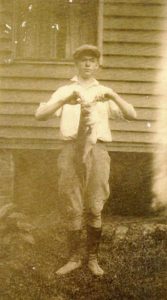 So during the 1950s, the good people of Rusk and Gregg Counties and surrounding areas decided they needed a new lake in their corner of East Texas. This is how Lake Cherokee came about. With the excitement of Lake Cherokee, added to Caddo Lake and also Lake Murvaul, Randy was set. He had the brilliant idea that Lake Cherokee and its lake house owners and devotees needed a magazine to record the important news of the day-mainly who was catching fish, how many and who was sadly, not. Oh, and all the comings and goings of the lake and its denizens would be properly covered as well, in a humorous and gossipy style. Since Randy owned a publishing company and had my mother and her friends to help when they were home from UT, along with some of his newspaper staff to pitch in, it was nothing at all for him to start up this little “rag” as he called it. Thus was born the “Cherokee Owl”.
To Randy, the name was a no-brainer because as a Rice U alumnus, he was crazy about owls. He even got hold of his own pet owl and named him Ozzie. This intrepid owl, Ozzie, quickly was installed as the mascot of my grandfather’s newest publication. I dare say that not many of you may have even known there was such a publication, but I have a copy of each and every issue and they are all delightful. They are chock full of tidbits including pictures, of “lot holders”, as they were called, in their boats catching the fish the lake had to offer…or sometimes didn’t. One piece from the November ‘51 issue shows a rather shadowy black and white picture of a couple of “lot holders”, a Mr. and Mrs. Leake, of Longview, trolling around in their boat on the lake. As the “Owl reporter” noted, “Mrs. Leake was using a Dipsey-Doodle on her new glass rod, and the “Mister” was using a Paw-Paw. Neither bait was attracting much attention from the bass, but they had just started out and weren’t discouraged at all. After getting this snapshot we wished them luck and resumed our cruise.”
I like to think of my grandfather and his “staff” of crack reporters, including my mother, in for fall break from Austin, cruising around the lake on a pretty East Texas piney woods afternoon, stopping now and then to capture images of a breathtaking view, children fishing, or a proud lot holder holding his string of twenty perch.
 The Cherokee Owl was a monthly publication, and there were about 20 issues altogether. The one I am writing about today happens to be the December 1951 issue, replete with the magazine’s logo of a Cherokee Indian costumed owl- Ozzie himself, one presumes decked out in green and red. This issue was called “The Christmas Issue.” But…there was something extra significant and fascinating about the December installment of the Cherokee Owl other than it simply being a rather festive issue of the magazine. The point being that the legendary and noted J.Frank Dobie, of much literary fame and renown in Texas and the world over, had very recently been in Henderson as a guest of the Henderson High School Latin Club. It so happened that my mother, an English major at UT, had been the star member of the Latin Club while at HHS, and there is not a doubt in my mind that Professor Dobie’s visit to Henderson was fortuitous, because somehow out of that visit, J. Frank Dobie agreed to write an essay for the Cherokee Owl about owls. Randy and his staff were pleased as punch to “land” (pun intended) such an illustrious writer and sage to pen a piece of prose for the Owl. As Randy proudly announced as an introduction to Professor Dobie’s piece…
“The Owl is pleased this month to add another illustrious name to its fast growing list of literary contributors. J.Frank Dobie needs no introduction anywhere the English language is read. For a good many years he has been telling the world about Texas and the great southwest…and even a lot of Texans have learned much about this great state that they didn’t know, through his fascinating tales. He is no stranger to East Texas, and as recently as October made his second appearance in Henderson at a lecture sponsored by the Henderson High School Latin Club….”
The article is typical Dobie. Informative, yet literary and not without some of his dry humor. To wit, Dobie wrote:
“…(the owl’s) cry is regarded by many as lonesome and solemn. Perhaps as to myself it is also cheering.The wild honk of the geese in the night brings the listener a kind of divine despair, a vague yearning for something, also vague, far away, that we know we can never attain to but that lifts us up even while we are held to the ground.”
 To me, this is a very beautiful phrase and it gives me a sense of pride and amazement that my own grandfather was in a position to publish his little “rag” and delight his readers with the insight of a writer of Dobie’s calibre. If I had only known this while I was a student at UT in the 1970s, going over to Dobie Center on the Drag to make copies for my own classes. And who knew that the Cherokee Owl, which frankly was pretty much a hobby of my grandfather’s (if you can’t tell by reading this so far) had a serious and uplifting quality to it as well. If you are ever in Austin, you can go to the Harry Ransom Center and if they let you, I am sure you will find the original manuscript of the article that was the result of the time that J. Frank Dobie came to Henderson and wrote a story for my grandfather and his Cherokee Owl.
Story Submitted By Elinor Seeley